Queer, while wonderful, is an umbrella term and a way of creating cultures in opposition to heteronormativity. It’s not a specific orientation or set of imposed experiences. Queer is a word we choose, and that’s gorgeous. But we need something more. And pan, while wonderful, both makes the assumption of attraction to all genders (as opposed to the myriad ways in which non-monosexual people experience attractions), and focuses solely on our individual internal experiences. It’s about attraction- and that is marvellous- but it has nothing to say about how those attractions play out in a heterocentric, monocentric society.
Bi is important because we need a word (or set of words- biromantic is as important as bisexual) that both locates us as nonmonosexual and acknowledges the implications that has for our lives. A word that is specific to who we are within the umbrella groups where we locate ourselves, that acknowledges our nonmonosexuality, and that doesn’t gloss over the fact that this means that we will spend our lives straddling and navigating multiple binaries that refuse to have spaces created between or outside of them.
A word that acknowledges that we constantly, in a myriad of ways both personal and relational, are forced to occupy positions at, or on both sides of, a boundary or threshold. I don’t know any other word that does that.
And it is only if we can name our experiences, call them out and show them for what they are, that we have a hope in hell of doing anything about them.
Let’s start at the beginning: nothing shocking has happened here.
I’m going to say that again. Even gonna throw in some italics for emphasis. Nothing shocking has happened here. Survival sex work is a thing that economically marginalised people do all the time. It is not exceptional. It is ordinary. It would be shocking if asylum seekers hadn’t been engaging in sex work to get by.
Think that doesn’t make sense? Let’s look at it from a practical perspective, shall we? People will almost always do what they can to create liveable circumstances for themselves. They’ll do what they can to get by. For most of us, that means doing things like getting an education, getting a job. If we can, we get a job that satisfies more than just our need for money to survive- but most of us have taken on crappy work to keep a roof over our head when we had to. Again, for most people most of the time, the work we do is above-board. If you can’t get a full-time job, though, you’ll get by as best you can. You’ll take on nixers here and there and see if you can make it add up. Sometimes above-board, sometimes under the table.
Now, put yourself in a situation where above-board work is explicitly forbidden.
The rest is, of course, over at the Tea Cosy’s new Freethought Blogs home. If you haven’t updated your bookmarks/follows/RSS/however else you keep track yet, then please do! For one thing, I won’t always be crossposting from here. And for another, I don’t crosspost everything, you know…
Ireland’s women’s rugby team are, as I type, having a phenomenal World Cup. A hard-fought win against New Zealand- who’ve won every World Cup since 1998- followed by a decisive 40-5 victory against Kazakhstan has us through to the semi-final this Wednesday evening. And- just like you USians with women’s soccer football this year- Ireland’s finally waking up to the fact that we have a world-class team that we should be paying attention to. In the middle of all of this, the Sunday Independent- one of Ireland’s major broadsheets- published an article today on the growing popularity of rugby among Irish women. The title? “Niamh Horan on women in rugby: ‘I never play a game without my tan‘”. Yep. It starts with this:
There were so many things my nan never knew about me. I couldn’t tell her. She wouldn’t have understood. She would have worried about me endlessly. My meaning and her understandings would have been too different. So I never told her that I was queer, or that I didn’t believe in the religion that she built her life around. My meanings- that here is how my heart is made, that here is where my love of understanding and truth took me- would not have been what she heard. That disconnect, and how much I know it would have hurt her to hear those things, kept me from ever sharing them with her. I couldn’t inflict that worry on someone I love so much. That tears me inside.
After FOUR WHOLE YEARS here at wordpress.com, the Tea Cosy just got some shmancy new digs over at Freethought Blogs. I’ll be copying links over to here for a few weeks, but not for forever, so get those bookmarks updated!
This post does exactly what it says on the tin. I’m gonna be talking about roller derby. And I’m gonna ask you for some of that sweet sweet cash.
What we’re doing
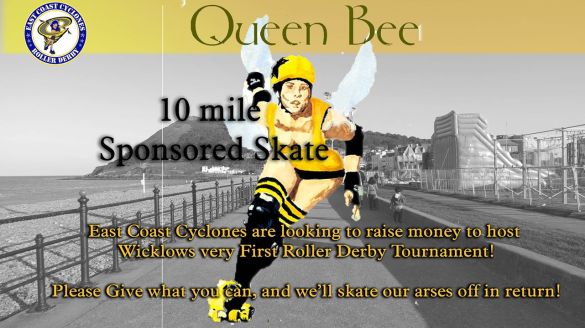
My derby team, the East Coast Cyclones, are doing something seriously awesome this month. We’re hosting our very first national derby tournament- which also just so happens to be the first of its kind in the country. The Queen Bee Tournament is Ireland’s first competition for establishing teams and B-teams.
I know. Kind of a big deal.
Why would you do that?
Why would we put ourselves through organising a tournament? Why an establishing/B-teams tournament?
You see, derby has kind-of exploded in Ireland in the last couple of years. While there are a few teams that have been around since as far back as 2008 (I’m lookin’ at you, Cork Firebirds and Dublin Roller Derby), most of us popped up in the past two years or so. Loads of us have just started playing actual games in the past year. And while we love watching the established A teams kick ass on the track (and oh gawd do they kick ass), we want in on the action too. The derby action.
So we’re hosting a tournament for the rest of us.
But, like, aren’t you guys like.. less good? Why would I support less-good?
It’s true. There are skaters in this country (especially on those A teams) who could destroy the likes of myself in a matter of nanoseconds. At least, there are right now. But that doesn’t mean the rest of us can’t put on a good show and fight some hardass derby. We’ve all been training our butts off and, let me tell you, the standard of derby in the newer teams in Ireland has gone through the roof in the last few months. It’s going to be a hell of a show.
Also? There’s nothing like watching a tournament with teams that are pretty darn well matched to each other. The Queen Bee is up for grabs and I have no idea where it’s gonna go.
How awesome is that, like?
You mentioned a small matter of cash? Money, dollars, euros, pounds? That kind of thing?
Doing this kind of thing is expensive. Pricey. Not cheap. And a small-town derby team like the Cyclones? We’re not exactly rolling in cash. We’ve got halls to rent, tape to buy, mile-high stacks of sandwiches to make, and a million other tiny things that add up to a hefty chuck of currency to make this happen.
So we’re gonna do what we always do. We’re gonna skate.
Tomorrow evening, we’re taking to the Bray Promenade for a 10-mile sponsored skate to help fund the tournament. We’re gonna skate our bums off! And in return, all we’d like are your sweet, delicious donations.
Do us a favour? Click on the picture below and throw a coupla quid our way, won’t ya? And if you haven’t the cash (I know the feeling!), give us a share and get your loaded friends to support us. G’wan. Do it for the derby.
I do feminism. I really do believe that the personal and political are inextricably linked, and I try to live in a way that takes that into account.
I believe in body positivity. I believe- I know– that all different kinds of bodies can be beautiful. I mean, there’s people of many shapes and sizes who I’ve found hot as hell in my time, and I’m just one person with one reasonably-narrow set of preferences. Bung in the rest of the world, and you’ve got a hell of a lot of people appreciating just about any kind of physique you can imagine.
I believe in appreciating our bodies for what they can do, not just what they look like. I know that this can be problematic in its own way- especially given our ableist views on what that means- but one of the things I’ve grown to love in the last year and a half is seeing my body as a tool for learning, developing and doing. Bodies aren’t just for looking at. They’re how we interact with the world around us, and that is incredible.
I believe in the understanding that even though health, abilities, competition and joy are far more positive reasons to exercise than looks, they still don’t apply to everyone. Nobody owes anyone else prettiness or fitness. We get to set our own priorities based on our own circumstances, abilities and desires, and they’re nobody’s business but our own.
I think that the very idea of “everyone’s beautiful” has its own problems, because so fucking what if you’re not beautiful? So what if you’re not symmetrical and skinny and young and whatever the hell beautiful is supposed to be these days. It doesn’t make you less important. Or less interesting. I want to get the hell away from the idea that there’s one thing- one anything– that everyone needs to be. Unless that one thing is just plain respectful and kind.
I believe that the ways society tears us down are toxic. We live in a constant state of negative marking- not pretty enough, not skinny enough, not fit enough, not rich enough. We can never be enough, and that destroys our enjoyment of all the things that we are. I want to be part of a different discourse to that.
How often do you hear something like that? You’ll tell someone that they’ve done something brave- conquered something that scared them- and the first thing they do is deny that it felt the slightest bit brave to them. They were terrified the entire time.
I wasn’t brave. It took me two tries to even go into that room- the first time I panicked.
I wasn’t brave. I had to hold my hands together, they were shaking so hard. And- oh god- when it was done I went home and locked the door behind me and curled up and cried.
I was awkward. I was scared. I was weak.
I wasn’t brave.
Feck that. I don’t think that brave feels brave. We imagine that bravery feels powerful- feels like facing your demons, overcoming them and triumphing.
I don’t think it’s supposed to feel strong. Not all the time, anyway. I think the bravest things we do are when we feel weak. Those times when you feel tiny and scared, when you don’t know how you’ll get through that thing you have to do, when you can’t look more than one step or moment ahead and in that tininess and shaking and nausea or whatever it is you somehow take that step and do a thing? When you’re a goddamn mess and the smallest thing is everything you can do?
That’s a hell of a lot braver than squared jaws, narrowed eyes and confident stares.
It’s one of the worst-kept not-a-secrets in the world that I keep an account on OK Cupid. Sometimes I even reply to messages on the thing.
As a Woman On The Internet, of course, I’ve had to come up with a few guidelines for people who want to contact me. Not that I think that any of the internet’s asshats are going to take the tiniest bit of notice, natch. The guidelines do two things: weed out the people who actually bothered to read my profile before sending me a message, and provide me with ammunition in case someone decides to get asshatty all over my inbox. (Fortunately, as someone over 30 who has had an account for a while, this only happens a couple of times a week at the moment. Win!)
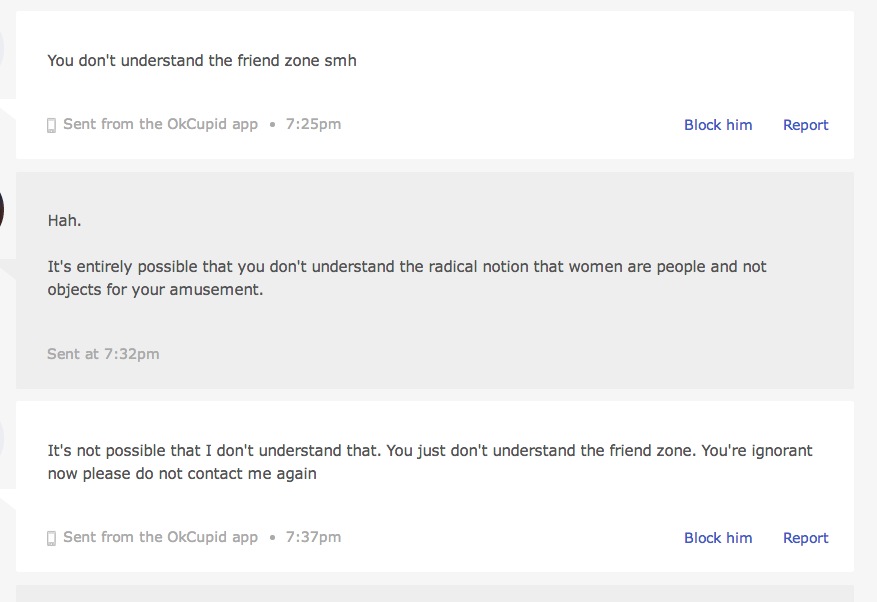
One of the things on the list? If you think the ‘friendzone’ is a legit concept, then we shouldn’t be talking. Which is relevant, because I just had this (thankfully brief) interaction over there:
Since when am I capable of not replying to something like that? Never, is when. I even drew a comic about it once, and since when do I draw comics? Hardly ever, is when.
First, for the snark: This is a white dude who would strongly prefer to date within his race and who thinks burning flags should be illegal. There’s not much risk of him ending up in my friend zone, if ya know what I’m sayin’.
But I’m feeling pretty generous today. It’s a gorgeous, sunny day. I’m sitting out on my balcony with my plants. I’m feeling happy with myself. It’s the kind of day where I can summon up a bit- just a bit- of empathy even for the overtly racist misogynists among us.
Just in case they’re reading*? Here’s what I’m saying to that guy on OKC, and the thousands-upon-fucking-thousands like him:
I sincerely hope that some day you look back on your current perspective with a wry sense of mortification. I hope that you learn to treat the people you are attracted to with no less consideration for their own agency than your own. I hope that you grow to have full, rich and varied friendships with people of all genders, regardless of whether you’re capable of being attracted to them. And I hope that you learn that no matter how heartbreaking unrequited love is, it’s nothing in comparison to a culture that treats you as worth nothing outside of your appeal to others.
Because what the ‘friendzone’ teaches us is that you don’t see the people you’re attracted to as fully human. You can’t see that they have motivations that have absolutely nothing to do with yours. That your attraction to them- that stomach-churning, gut-wrenching feeling you can’t but have around them- doesn’t oblige others to feel a particular way, or to act in the way that you’d like them. And someday I hope you understand that, right in your guts. I really, really do.
In the meantime, though? Get the hell out of my inbox, thanks.
I just got into a leeeeeeetle disagreement over on the Facebooks over this:
My views on this are that Clare Cullen is a massive ledgeface* who you should all go subscribe to immediately because she is saying words that basically mirror rants I have inside my head every single time anyone runs for election, ever. We don’t elect people to be Official Fixers Of The World and Havers Of Opinions. We elect people to particular jobs with specific responsibilities and powers. It’s insulting to the electorate (you know, the people who you’re asking to employ you) if the material you’re using to persuade people to vote for you is either vague to the point of meaninglessness or refers to things that are drastically outside the remit of the job you’re actually applying for.
Anyway, one of the people she targets is the Socialist Party** candidate, Paul Murphy, who’s looking to get reelected to the European Parliament. Grand so. She’s got criticisms that I see as legit- overly negative campaigning with a lack of actual alternatives put forward. Anyway, since I’m a leftie myself and since Ireland is a tiny country where everyone knows everyone, it was inevitable that a bit of a palaver would ensue. Which is fine. It’s just that.. there’s something that happened there that I disagree with hard enough to write a blog post about it, and that was this comment by CH- someone who, by the way, I respect a shedload and who gave me the okay to :
Paul is running on a platform of party ideals/alternatives (anti-capitalist) to domestic policy and EU. It is merely to have a voice to raise issues that are railroaded in the EU and their wider agenda of Austerity… maybe you missed the part about wanting a socialist alternative not band aids for bullets wounds of capitalism. It not about legislative change which is a narrow outlook of oppositions role anyway.
Okay. You see, this? This is something I have a huge issue with. Not necessarily when it comes to policy or perspective- I agree with a bunch of Murphy’s views. But with CH’s defence of his actions. Let me explain why.
The Role of a Legislator Is To Legislate
The first thing that I want to take issue with is this:
It not about legislative change which is a narrow outlook of oppositions role anyway.
There are many ways to do opposition. Shedloads of ’em. Despite what you hear, working through parliaments (as well as stuff like voting etc) is just one way of many to create change. In fact, I’d go further than that. The vast majority of the time here in Ireland, any legislative change that is enacted on social issues happens after shifts in public opinion. If you want to create change without engaging directly with the legislate process? Do that! Do grassroots work. Educate and communicate your views. Work at the local level to create models of how you’d like things to be done, and put in the everyday work of keeping those things going. Protest and demonstrate. Campaign, or provide support to campaigns. Write a book or a blog, submit articles for people to read, start a vlog if you like.
There’s many, many ways- most of which I’m sure I haven’t mentioned- that you can help to bring about the change you’d like to see which don’t involve legislation. Legislation is one tiny piece of a huge jigsaw.
But if you’re going to apply for a job as a legislator? I expect you to be interested in legislating. Period. End of sentence.
I expect you to take that job with the intent of working your butt off for your entire term at legislating. And I expect you to show me that you can get legislation passed. I expect you to be willing to grit your teeth, hold your nose and work on the compromise legislation that isn’t exactly what any of us want because the alternative is so much worse. If you’re not wiling to do that, then you have no business looking for that job. There are many other spaces where your voice would be better used.
Hell to the Yes, I Want That Bandaid.
Let’s go to the next part.
maybe you missed the part about wanting a socialist alternative not band aids for bullet wounds of capitalism
To describe short-term legislative change as “band aids for bullet wounds of capitalism” is to use some pretty strong words and make some extremely strong assumptions. I’m going to take three premises out of this, and address them in order:
That the harm caused by capitalism can be likened to a bullet wound- that is, is not just extremely serious but requires urgent action.
That the small changes possible through immediate legislative change can be likened to a band-aid: something that will cover the wound, staunch the bleeding, but won’t do anything about the bullet lodged within you.
That tackling immediate needs and creating long-term substantial change are mutually exclusive.
My answer to the first? Yep, there sure are some extremely harmful things going on which need to be addressed urgently. I wouldn’t personally use the single term ‘capitalism’ to describe the forces causing these- I think it’s a whole lot more complicated than that and there’s a lot of forces involved, and I also prefer to think of capitalisms as opposed to one unitary thing. But I have a feeling that that kind of pedantry isn’t terribly useful right here. Let’s agree that there’s some seriously harmful stuff happening and we need to do something about it, sharpish.
It’s when we get to the second part that we’re going to start to disagree. You describe the kind of legislative change possible from the EP as bandaids. I’d use a different metaphor: they’re more like first aid. Sure, they’re not the well-equipped intensive care unit of culture-wide change creating a society where each of us is able to live without fear of destitution and has real opportunity to thrive. But first aid will keep you alive. First aid is the thing that’ll keep you breathing until the ambulance gets here.
Theory can never, ever trump practicality
That third premise is one I have even more difficulty accepting than the other two. If that’s the case, then you need to take a long, hard look at where your theory is coming from, because I have no interest in theory that puts itself before people’s real and immediate needs.
A real alternative to the way we’re doing things now is all well and good, but some of us- a lot of us- don’t have the luxury of theory. Because of piss-poor, inadequate legislation here in Ireland, people now have a higher chance of surviving pregnancies that threaten their lives than they did a couple of years ago. Piss-poor, inadequate legislation means that as long as I don’t work in a school or a hospital I probably won’t get fired for not following Catholic dogma, the way I could back in the ’90s. It’s ludicrous that pregnant people have to travel overseas for abortion services if their lives aren’t in danger, and it’s a disgrace that the RCC can hide behind ‘ethos’ to force people into closets. But it’s better than nothing, and I’m glad we don’t have to live without it.
In short? If you’re not going to actually attain that socialist alternative next week then fuck yes I would like some bandaids please. And if you can’t hold your nose and enact piss-poor legislation that is all you can get but better than nothing? Then there are far better places to take your activism than Parliament.
*Translation for non-Irish people: most excellent person who does things I approve of greatly.
** Surprise for you USian people- ‘Socialist’ isn’t actually a dirty word ’round this neck of the woods. Woop!



 considertheteacosy.wordpress.com